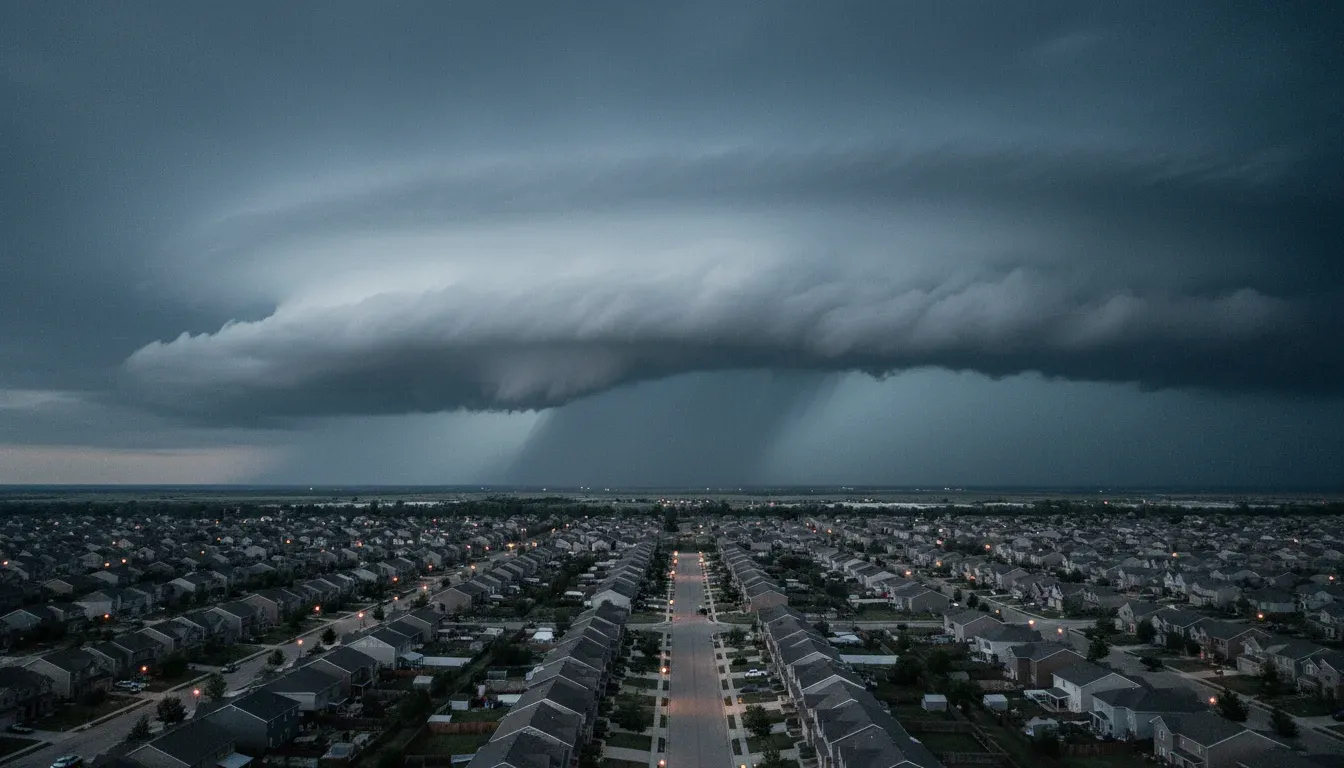
Hail risk is local — and cumulative
Hail is not a national statistic. One corridor of a metro gets pounded year after year while a neighborhood across town stays quiet; two addresses a short drive apart can live in genuinely different hail climates. And the risk is cumulative — the roof over your head carries every storm that has crossed it since it was shingled, whether or not you were home for any of them.
Yet almost everything written about hail risk is written at the grain of a state or a season. Hail Sentinel's Insights tab now answers the question at the grain you actually live at: what is the hail record for this address? How often hail has come through, how big it has gotten, when in the year — and even when in the day — it tends to arrive, and which storms were the ones worth remembering.
What the record shows
Open Insights and the app builds the history for the address you're watching: a count of hail days, the largest hail on record nearby, and how many of those days were severe-capable — then the shape of it all. A season-by-season chart. A longer-run trend. The months hail concentrates in, the hours of the day storms tend to strike, and the compass direction they most often arrive from. Below that, the notable events: the individual storm days that defined the record, each one opening into its own detail view.
One rule runs through the whole page: every count names its ground. Nothing on the surface says "nearby" or "your area" and hopes you don't ask — every scope is stated as an explicit distance, "within so-many miles," so a tight-ring count and a wider-ring count can sit on the same screen without pretending to be the same fact. Where the two disagree, that isn't a contradiction. It's two honest answers to two different questions.
Two ledgers, honestly labeled
The history is built from two records that are good at different things, and the app never lets one borrow the other's authority.
How often · radar-derived estimate
Storm records from the production pipeline
Frequency comes from radar-derived storm records — the same records the system that powers live alerts writes while storms are actually happening. Radar watches every storm whether or not anyone is standing under it, which is what makes it the honest source for how often. But radar reads the storm, not the ground: a radar-derived hail day is an estimate, labeled as one, and it is never treated as proof of what landed.
How big · measured on the ground
Filed reports of actual stones
Size comes only from filed ground reports — cross-source-deduplicated entries from public storm-report networks, each one a stone a person measured and wrote down. No modeled size ever stands in for a measured one: if the record says hail got that big, somebody held the evidence.
The split matters because each source fails differently. Ground reports are filed where people are, so left alone they overstate cities and understate open country — which is why the app refuses to count frequency from them. Radar sees everywhere but estimates; so the app refuses to let it testify about size. Two ledgers, each kept honest by the other's existence.
Three claims the page keeps separate
Most hail-history products blur one crucial line: the difference between what happened near you and what happened to you. Insights is built around refusing that blur. Three different statements appear on the page, and they never collapse into one sentence:
- "Hail came within a stated distance." The counts — hail days, severe-capable days — are counts of storm days within the ring the page names, in miles. They are neighborhood facts and they say so.
- "A storm's radar footprint passed directly over your address." A separate badge, and a claim about coverage only: it certifies where the storm was, at any size — not what it dropped on your shingles.
- "A stone this size was measured — this far away." Every notable event's headline size carries the distance to where that stone was actually measured. A two-inch stone measured twenty miles out is the area's maximum, not your street's — and the app prints the distance rather than letting the big number drift onto your address.
Notice what is not on that list: "your roof was hit." The record holds no claim at that grain, so the app never makes one — not in a headline, not in a badge, not by implication.
A quiet record is not a verdict
Here is the caveat that has to travel with every hail history, ours included: the record undercounts, and it undercounts unevenly. A ground report only exists if a person was near the hail, recognized it, and filed — and close to any single address there are only ever a handful of possible witnesses. The radar-derived side is broader, but it reaches back only a few seasons; storms before it simply are not in that ledger.
Fewer eyes on the sky means fewer entries in the ledger. It never means less hail.
So the app reads absence the only honest way: where observers are thin, it tells you the record can't be corroborated there — it does not convert silence into safety, and the confidence it states scales with how well your area is actually observed. If your history looks quiet, treat it as a lower bound on your exposure, not a clean bill for your address. This matters most in exactly the places the record is thinnest: rural and newly built areas, where hail is no rarer but witnesses are.
When a roofer knocks
The knock comes a day or two after any loud storm: someone at the door saying last month's hail did real damage on this street, and yours is next. Sometimes they're right. The point of a per-address record is that you no longer have to take a stranger's word for what the sky did.
Open the history and check the claim against the ledger. Was there a hail day here in that stretch? Did any storm's footprint actually cross this address, or did it pass a town over? How big were the stones anyone measured — and how far from your door? A door-to-door story about "the storm that hit this neighborhood" should have to survive the record for this neighborhood. Now it does.
And the boundary, stated plainly: the history is not an inspection, and it is not a damage claim. A loud record does not prove your roof is damaged; a quiet one — see above — does not prove it is fine. What the record does is let you have the roof conversation with the ledger in your hand: informed about what came through, honest about what nobody measured, and unswayed by a stranger's version of either.
Free and Premium
The history at your current address is free — the full record, every panel, refreshed seasonally. Premium changes the cadence and the reach: the record is kept refreshed daily, and it extends to every saved location on the account, so the lake house and the rental carry ledgers of their own.
It lives in the Insights tab, in the app today — on iOS and on Android . And if a storm does come through next season, the same app that alerts you while it happens is the one writing the next line of your address's record.