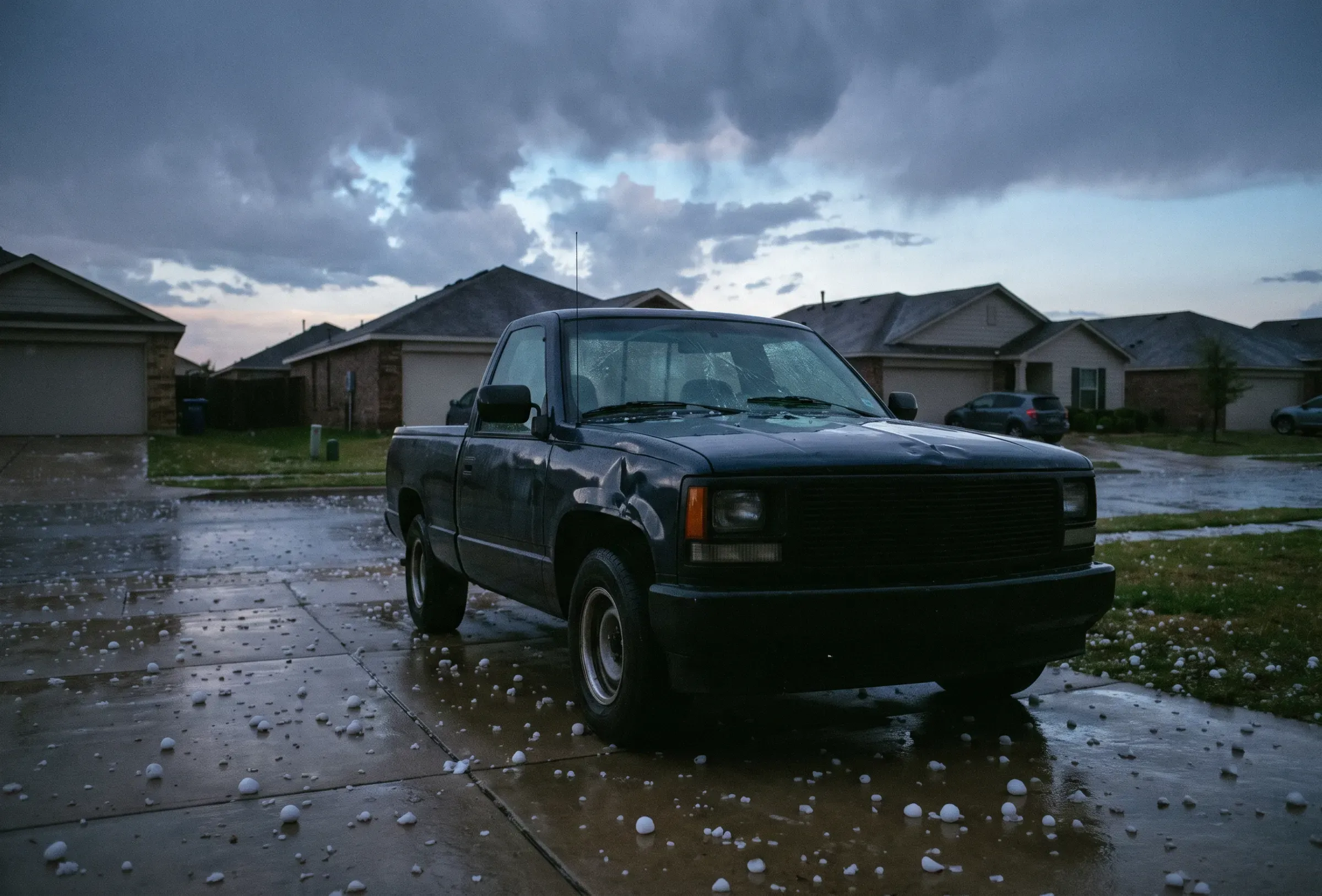
Born from a $9,400 hail bill.
Every weather app on the phone. A hail cover folded in the garage. Still a wrecked vehicle in the driveway. Hail Sentinel is the answer to that morning — for the households it happens to, and for the businesses that clean up after.
The day everything changed.
April 2023. I walked outside to a wrecked vehicle in my own driveway — $9,400 in damage, and a hail cover still folded in the garage.
The repair was worse than the storm. Weeks waiting on dent appointments, parts on backorder, over a month without a car while my HOA handled the roof. Alerts, claims, repairs — the whole chain was broken.
I had every weather app imaginable. Premium subscriptions. An expensive hail cover sitting in my garage. But with only minutes of warning, I couldn't protect my car.
Nobody had built it — and it was not just my problem.
I searched everywhere for a better solution. Something that could give me real advance warning — enough time to actually protect my assets.
Every app offered the same thing: basic radar, a generic forecast, and an alert that arrived after the ice did. The pieces all existed — dual-polarization radar, machine learning, cheap compute — but nobody had assembled them against this one problem.
And the same gap was failing whole industries. Insurers priced hail off county-level data. Contractors had no way to tell which streets actually got hit. Farmers watched crops destroyed with zero advance notice.
Building something just for myself was never the goal. If the technology could save one car, it could protect entire fleets, farms, and portfolios.
Key milestones.
One hail event in a driveway, to an app on the App Store and a console opening by invitation.
The hail event
$9,400 in vehicle damage, with every weather app on the phone and a hail cover folded in the garage. The breaking point that started all of this.
Research & development
Began analyzing raw radar, training the first Anvil detection models, and building the data infrastructure that now serves both the app and the business console.
Platform built
Built the consumer mobile app, and began the business console — both reading from the same real-time radar processing core.
Beta & early access
Anvil goes live in production — machine-learned models plus calibrated statistical models scoring radar across the Continental US in real time. The mobile app enters closed beta with real households.
The app goes live
The app ships on the App Store in August 2026, and the business console opens by invitation. Free on iPhone and Android.
Where we intend to go
We intend to open the business console past the invite list ahead of the 2027 hail season, and to publish pricing when it is settled. That is the plan we are working to, not a commitment we have made.